Running a business has become increasingly complex over the years. Consumers expect a seamless shopping experience across every channel: physical stores, mobile devices, and e-commerce websites. And now, with AI reshaping what's technically possible, those expectations are rising faster than ever.
A major challenge remains: the use of multiple IT systems that do not effectively communicate with each other. This makes your teams' jobs harder, leads to outdated information for both operators and customers, and creates an unclear view of performance. That's wasted time and money. What's changing is the scale of the opportunity to fix it. Artificial intelligence and agents are beginning to restructure how business systems work, how quickly they can be deployed, and how much of the day-to-day execution they can handle on your behalf.
Here's what you need to know.
ERP systems: A quick definition
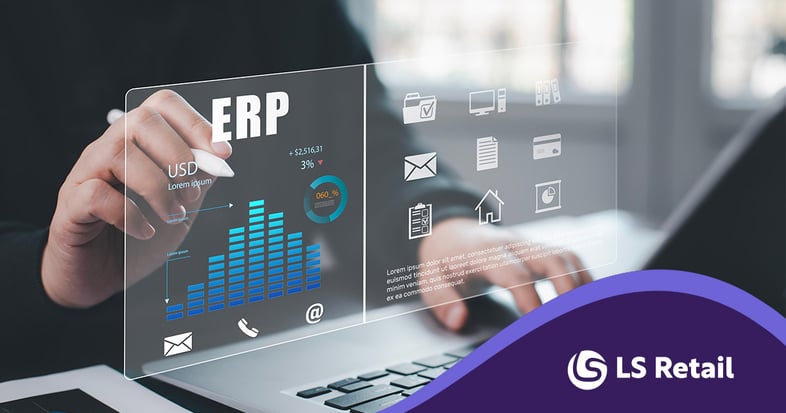
An Enterprise Resource Planning (ERP) system is software implemented across your entire business to improve data flow and streamline operations. A good ERP will be able to streamline operations in your business, reduce costs, increase productivity and deliver an improved overall customer experience.
What's typically included:
Financial management. Your ERP centralizes your accounts, automates financial reporting, and gives you a real-time view of cash flow, costs, and profitability across every part of your business. No more reconciling figures from separate tools at the end of the month.
Supply chain management. From purchasing and supplier management through to replenishment and fulfillment, your ERP keeps the entire supply chain visible and connected. You can track orders, manage lead times, and respond to disruptions before they reach your customers.
Warehouse management. Your ERP handles stock counting, goods receipt, picking, packing, and dispatch from a single database. Inventory levels update in real time, so what your staff sees in the warehouse matches what your customers see on the shelf or online.
Cloud and on-premises ERP
In the past, most ERPs were on-premises, that is, they were hosted on the retailer’s hardware and on in-house servers. The retailer’s internal IT team was responsible for system updates, upgrades, maintenance and security.
Today, however, ERPs have moved massively in the cloud. Cloud-based ERP (also called SaaS ERP, with SaaS meaning “software as a service”) has several advantages over the traditional on-premises one:
- It is automatically updated by the ERP supplier. The retailer doesn’t need to do anything - SaaS software guarantees that you are always automatically on the latest version, with all the functionality that comes with it.
- The ERP provider takes care of security and compliance with legal requirements.
- Capital expenditure is lower: there is no need for hardware and servers, and the cost of running and maintaining the system, is included in the subscription price.
- It’s easier to plug in new functionality or deploy extra applications.
Point of sale: The front line of your operation
Your POS is no longer just where transactions happen. A good POS connects directly to your inventory, your customer data, your promotions, and your ERP, so every sale updates your business in real time. Payment types, order tracking, loyalty rewards, buy-one-get-one offers: it all runs through one touchpoint, and your staff spend less time on admin and more time with customers.
Most modern POS terminals run on mobile devices or tablets, which means your staff aren't tied to a fixed till. They can serve customers, check stock, and complete transactions anywhere on the shop floor. Wherever the customer is, your team can meet them there.
The one requirement that doesn't change: your POS and your ERP must be fully integrated. Any lag or disconnect between them means your stock levels, pricing, and customer data fall out of sync. That creates errors at the point of sale and wasted time fixing them in the back office.
What AI is changing about ERP
AI and agents are no longer just add-ons to ERP software. They are beginning to change the architecture of ERP itself: how decisions get made, how processes run, and how much human intervention is actually required. The term emerging to describe this shift is headless ERP, which means the ERP system moves into the background, while AI agents and other applications take over running processes and interacting with users on top of it.
From manual steps to autonomous action
Traditionally, ERP required your team to interact with it directly, inputting data, running reports, triggering actions. The next generation of ERP operates differently. AI agents can mediate, decide, and execute processes automatically, sitting on top of your ERP and acting on its data without waiting for a human to initiate each step. Think of demand forecasting that adjusts automatically based on live sales data, seasonal patterns, and supplier lead times, without a planner having to run a report and make a manual call. Or staff scheduling that recalibrates based on foot traffic and performance. The system acts. You guide it.
Faster implementation, lower cost
ERP implementation has historically been expensive and slow. Large projects often take years and cost businesses a significant amount before they see any return. AI is already changing that. Agentic AI can now automate large portions of the design, configuration, testing, and training phases of an ERP implementation. What once took months can be compressed into weeks. For your business, that means a shorter path to value and less risk tied up in a long rollout. Early adopters of AI-integrated ERP are already reporting measurable EBIT improvements of 5% or more as a result, according to a report from McKinsey.
Your team's role shifts
As AI takes over routine transactions and decisions, the people working with your ERP stop executing processes step by step and start setting direction, reviewing exceptions, and governing outcomes. The daily interaction moves away from navigating screens and menus, toward overseeing results and steering the system's decisions. This requires different skills than traditional ERP use. Businesses that build AI fluency alongside operational knowledge will get more from their systems and adapt faster when the technology moves again.
A stronger foundation for AI adoption
AI agents are powerful, but they still need a reliable backbone. Your ERP remains the system of record: it ensures your data is accurate, auditable, and compliant. What changes is how users interact with it, and how much of the day-to-day execution AI handles on their behalf. The businesses gaining an edge right now are those investing in a clean, well-structured ERP foundation, because that's what allows AI to scale effectively on top of it. A fragmented or legacy data environment limits what AI can do. A single database with consistent, real-time data across your purchasing, sales, inventory, and customer records unlocks it.
The bottom line
The question isn't whether AI will affect your ERP. It will. The question is whether your platform and your team are ready to take advantage of it when it does. It's also important to have an ERP that comes with all the industry-specific functionality you need, or that can easily integrate to a business operations platform, and that's built to handle AI capabilities as they mature. After you've implemented the right solution, you'll wonder how you ever got things done without it.
If you would like to discuss what this could look like for your operations, we're here to help. Contact us today.