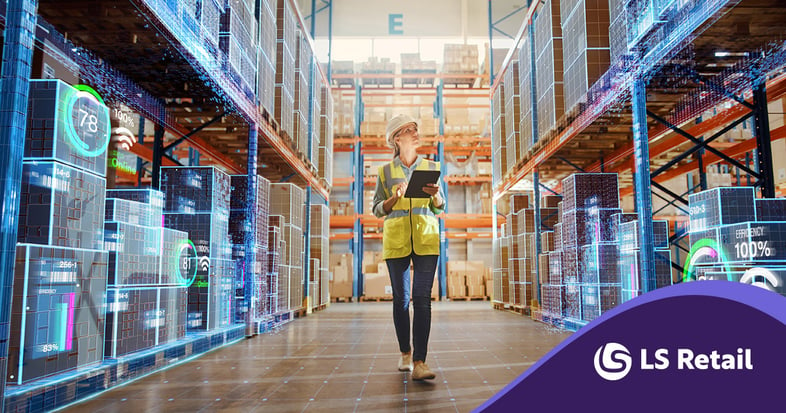
Inventory has always been one of retail’s toughest balancing acts. Carry too much stock, and your revenue and shelf space are tied up. Carry too little, and you deal with missed sales and frustrated customers. As a retailer, you know that today's consumers are some of the most demanding yet. They expect products to be available instantly, whether they are buying an item online for curbside pickup or grabbing a cold drink on a hot afternoon. And they also expect you to leverage the latest technology to keep those shelves full.
Today, AI is completely rewriting the rules of successful inventory management. It is moving the industry away from stressful, reactive guesswork and toward intelligent, real-time decision-making across the entire supply chain. But as you find yourself looking for technology to support your current and future needs, it helps to understand how this landscape is shifting, and what it takes to actually succeed.
What is AI inventory management?
AI inventory management uses machine learning and predictive analytics to help retailers forecast demand, track stock levels, and handle restocking. Traditionally, this has meant looking closely at past sales data to predict what you will need in the future. For years, retailers have relied on these tools to:
While looking at historical data has drastically improved planning accuracy, inventory management is now expanding far beyond looking in the rearview mirror.
The next frontier in inventory management: Agentic AI
Where traditional AI focuses on predicting the future, agentic AI focuses on taking action in real-time. Instead of just looking at historical data, it can factors like connect live sales, upcoming promotions, and shifting weather to make decisions based on set parameters.
For example, instead of alerting a human manager that "Sunscreen is running low," an AI agent can autonomously:
-
Analyze the supplier’s current delivery timeline.
-
Compare alternative vendors if the primary source is backed up.
-
Execute and adjust the purchase order autonomously In this way.
AI agents move beyond supporting decision-making—they own and execute inventory workflows from start to finish, reducing delays, minimizing manual intervention, and ensuring faster, more resilient supply chain responses.
The challenge for successful AI: Fragmented data
Here’s the issue most retailers struggle with: separate systems. Your POS sits by itself while inventory is somewhere else. Your warehouse lives in a completely different environment. E-commerce is its own platform. Individually, they work, but together, they don’t really communicate. When your systems don’t talk to one another, you can only catch fragments of your data, and more often than not you’re left to connect the dots yourself.
A product might look available online but is actually out of stock in-store. Demand might be rising, but replenishment decisions don’t reflect it quickly enough. Different channels start operating like separate businesses.
Big retailers have learned this the hard way. Target, one of the largest retail chains in the U.S., recently admitted that its old technology missed nearly half of its out-of-stock products because the system falsely assumed inventory existed when the store shelves were actually completely bare.
The key to fixing this isn't adding another layer on top. First, you need a strong technology foundation that delivers real-time sales, inventory, supply chain, and customer data across your entire business. Once you have a unified base where your data actually talks to each other, you can successfully build a real AI strategy on top of it.
5 ways AI agents can support your retail inventory strategy
1. Smarter replenishment
Instead of ordering on fixed schedules, AI agents can continuously monitor demand signals and adjust replenishment in real time, automatically triggering and updating purchase orders as conditions change.
2. Streamlining supplier communication
Procurement can be a swamp of manual emails, delivery checks, and order confirmations. Retailers are now deploying communication agents to handle routine vendor interactions. This keeps data synchronized in real time and frees human teams to focus on strategic sourcing and negotiation.
3. Warehouse optimization
AI agents dynamically optimize warehouse operations by continuously recalculating picking routes, reallocating tasks, and correcting inventory discrepancies without manual intervention.
4. Real-time inventory adjustments
Today, a single pool of inventory has to serve in-store shoppers, online orders and mobile orders, and delivery requests simultaneously. AI agents can suggest stock transfers across stores and warehouses, helping retailers ensure stock is always positioned where demand is highest.
5. Automated order routing
When a customer clicks "Buy Now" online, an AI agent instantly validates stock across the entire network and routes the order to the best fulfillment location, minimizing shipping distances, lowering costs, and cutting delivery times.
The future of retail inventory management
As retailers continue to use AI and agents to build highly resilient, predictive supply chains, the baseline expectation for consumers is rising. Smart, connected data is now the foundation of an effective inventory management strategy.
To get there, retailers need the right platform to deliver centralized, real-time data across the business and enable AI innovation.
Contact us to discover how our global POS and operations platform can support your AI strategy.